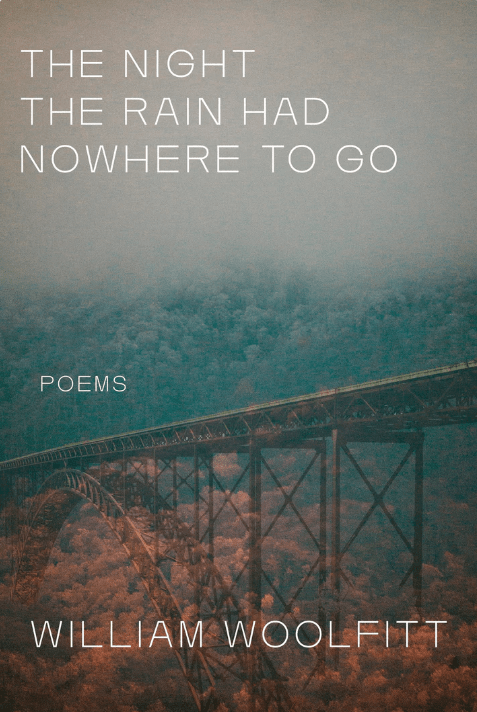
 The Night the Rain Had Nowhere to Go
 William Woolfit
 Belle Point Press
 June 2024
 ISBN: 978-1-960215-18-5
 76 pages
 PB: $15.95
 order here
In this latest collection by established poet William Woolfitt, he reaches across time and space to
take a no-holds-barred approach to exploring the intertwined experiences of Appalachian lives
and landscapes. Refusing to partake in the overly romanticized portrayal of the region that other
authors have penned, he forces his readers to see the damage wrought by the long-term
industrialization of King Coal, the complicit railroad companies, and the everyday residents who
rely upon these corporations to earn a living creating the “oil-spilled sea, the damaged air” (11).
Rather than demonize these workers, however, Woolfitt draws connections between the
destruction of landscapes and bodies, observing, “Now my body’s mined and stripped. / Incision
site a run-off ditch. Lead in my piss. Spine / and ribs busted by draglines” (13). At times, some
portions of the poems become a bit list-y but rather than seeing this as a fault, I perceive these
“lists” as ways to build momentum in the poems, a force that catapults readers into the sides of
Appalachia one might rather not see.
Woolfitt’s poetic commentary on this environmental devastation, however, does not only extend
to individual humans or corporations. He expands his critique to further link settler colonialism
to the industrial wreckage, a view common among Indigenous scholars and writers such as Kyle
Powys Whyte and Robin Wall Kimmerer but far less common among non-Native scholars and
especially non-Native creative writers. His inclusion of observations like “The Mënaonkihëla,
the Lenape call it: where banks slip and / erode,” invokes of the work of Maria Gunnoe, and
descriptions of how settler leaders deceived and victimized Chief Logan highlight how our
collective current circumstances of climate change, labor exploitation, and land extraction did
not begin with the Industrial Revolution but rather arrived with the settler mindset of dominion
over the land that preceded it (20). Woolfitt’s astute account here is particularly poignant
because West Virginia is one of only a handful of states, many of which in part make up the
Appalachian region, that do not recognize any state or federal tribes within their boundaries.
Yet, Woolfitt has a gift for portraying these historical and ongoing acts of violence with a sonic
eloquence that does not render such experiences more palatable but rather heightens our
perception of them, often through his selective choice of verbs and detailed nouns, such as
“Foot-beats, salt barrels, chanting as they load / broadhorns, keelboats” (16) and “All that the
trackmen tip from dumpcarts—rootlets, and clods of dirt, and knuck- / les of shale—hills up in
the July sun” (7). Such language, however, does not just describe hardships. He also invokes
music, both through the “Tracks” poems as well as incorporating individual lines of song, such
as “when the world’s on fire, tide me over in the rock of ages” (24) and “Can’t find a mule / with
her shoulder well” (9). Between the song lyrics and many more italicized lines that appear to
come from Woolfitt’s evident and extensive research for this collection, these poems stretch
beyond the covers that cannot contain them and weave their way like kudzu into the stained
fabrics of so many lives.
Jessica Cory is the editor of Appalachian Journal: A Regional Studies Review, published
since 1972 at Appalachian State University. She holds a PhD in Native American, African
American, and environmental literatures from the University of North Carolina at Greensboro
and is the editor of Mountains Piled upon Mountains: Appalachian Nature Writing in the
Anthropocene (WVU Press, 2019) and the co-editor (with Laura Wright) of Appalachian
Ecocriticism and the Paradox of Place (UGA Press, 2023). Her creative and scholarly writings
have been published in the North Carolina Literary Review, North Dakota Quarterly, Northern
Appalachia Review, and other fine publications. Originally from southeastern Ohio, she currently
lives in western North Carolina.

 Change Seven Magazine